
I’m Xinyu Guo, a third-year Ph.D. student in Computer Science at the University of Arizona. I am fortunate to be advised by Prof. Mihai Surdeanu in the CLU Lab. Before that, I received my B.E. in Computer Science from Shandong University in 2023.
Large language models increasingly reason through knowledge-intensive and open-ended tasks. My research focuses on LLM-based reasoning in these settings, along two directions:
- RL credit assignment for reasoning supervision: credit assignment is key to RL for reasoning, which needs fine-grained credit beyond RLVR’s outcome-only rewards. I tackle it from two angles: (1) efficient intermediate rewards, self-derived from the model’s own correct reasoning without annotation or an LLM judge (CogRE); and (2) from rewards to advantages, disentangling the varying query-specific rubrics in critic learning to estimate per-rubric values and advantages (DVE).
- Reasoning mechanisms: looking inside LLMs to understand how concepts and their logical structure support reasoning, by aligning sparse autoencoder features with concepts (AlignSAE) and taxonomies (TaxoSAE).
🔥 News
- 2026.10: “TaxoSAE: Rethinking Sparse Autoencoders through Taxonomic Logic” is released on arXiv.
- 2026.08: 🎉 “The Answer Lies Within: Self-Derived Rewards Enable Explainable Relation Extraction” (CogRE) is accepted to the EMNLP 2026 Main Conference!
- 2026.08: 🎉 “AlignSAE: Concept-Aligned Sparse Autoencoders” is accepted to TMLR!
- 2026.08: “Rubric Dropout: A Simple Way to Mitigate Reward Hacking in Rubric-as-Reward RL” is released on arXiv.
- 2026.06: 🏆 I received the Galileo Circle Scholarship from the University of Arizona!
- 2026.05: “Dr. DocBench: A Comprehensive Benchmark for Expert-Level and Difficult Document Parsing” is released on arXiv, and accepted to the LCFM Workshop @ NeurIPS 2026! [OpenReview]
- 2025.11: “Deep Research: A Systematic Survey” is released on arXiv.
- 2025.09: 🏆 I received the Science Graduate College Fellowship from the University of Arizona!
- 2025.07: 🎉 “QUEST: Query Optimization in Unstructured Document Analysis” is accepted to VLDB 2025!
📝 Publications
RL Credit Assignment for Reasoning Supervision
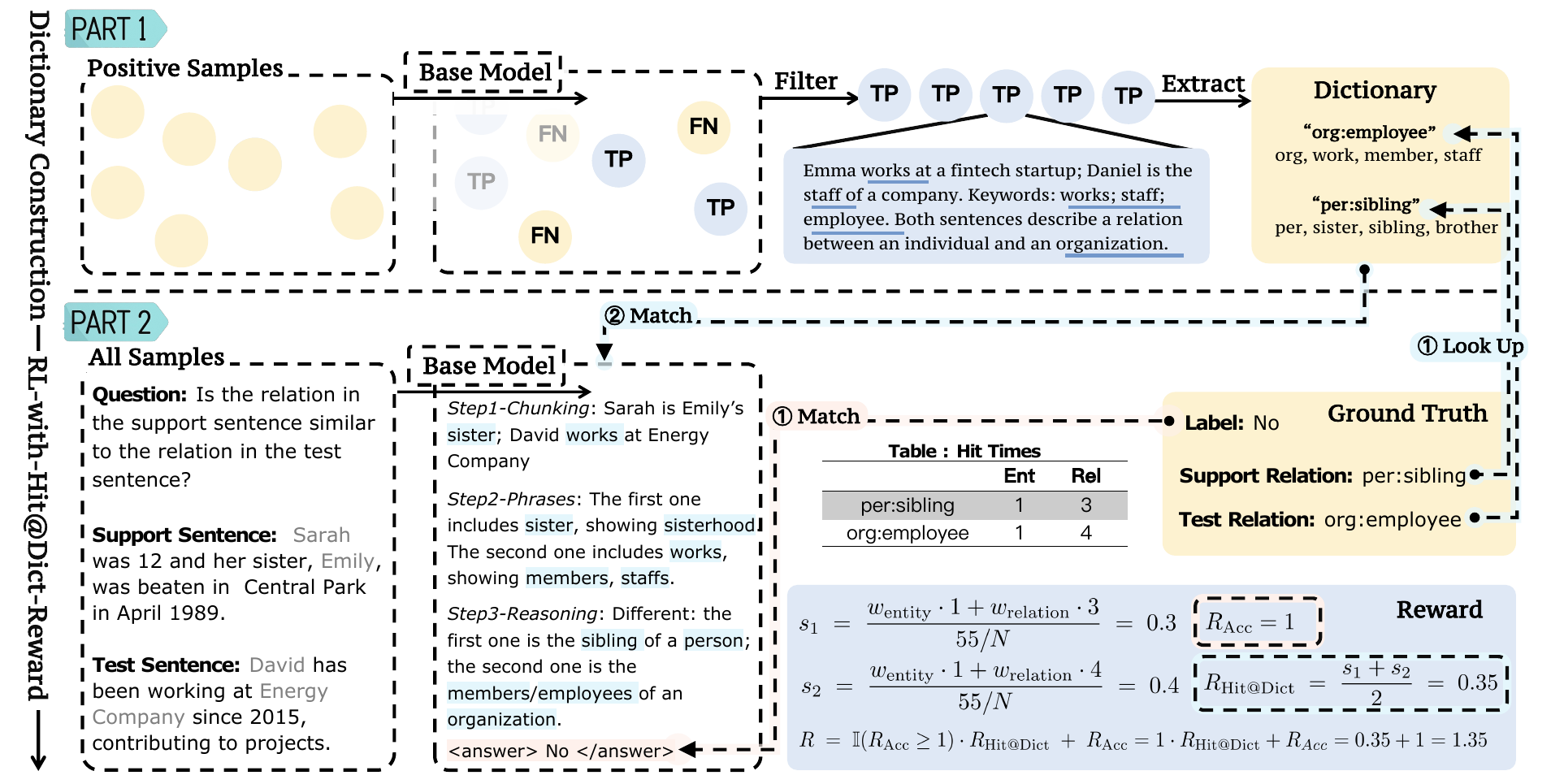
The Answer Lies Within: Self-Derived Rewards Enable Explainable Relation Extraction
Xinyu Guo, Zhengliang Shi, Minglai Yang, Mahdi Rahimi, Mihai Surdeanu
- Identified two failure modes of LLMs on realistic one-shot relation extraction: attending to irrelevant tokens, and predicting relations at a granularity mismatched with human annotation schemas.
- Proposed Hit@Dict, a self-derived intermediate RL reward that credits relation-bearing phrases in the reasoning trace, using a dictionary mined from the model’s own correct explanations; no LLM judge needed.
- Improved F1 by +73.7% (relative) over accuracy-only RL on one-shot NYT29 and human-rated explanation quality by +54%.
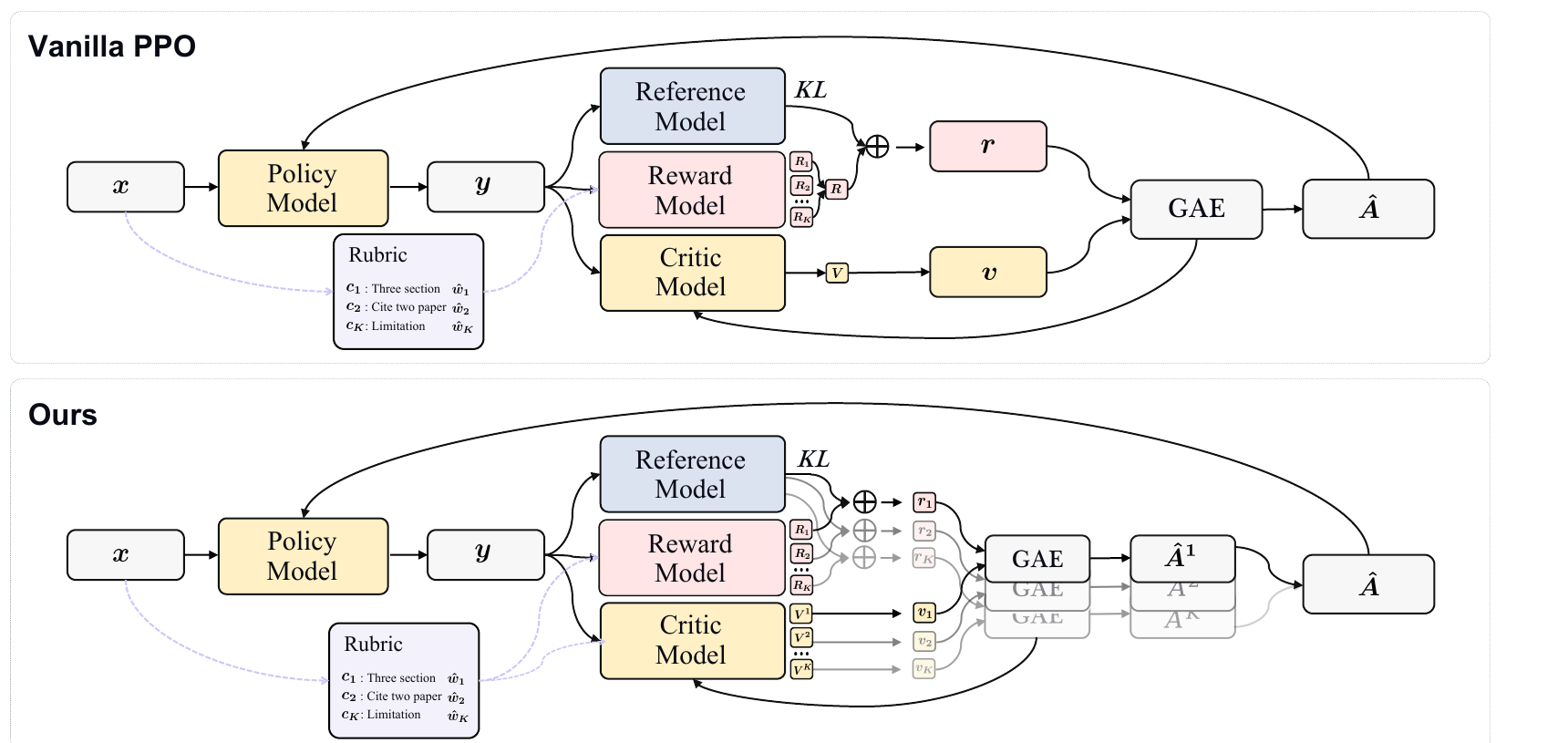
Disentangled Value Estimation: Rethinking Scalar Critics in Rubric-Based RL
Xinyu Guo, Minglai Yang, Chen Xu, Lingyong Yan
- Identified a bottleneck in the critic model for rubric-based RL: the critic sees only the query and response prefix, yet is trained on a scalar reward that collapses many query-specific rubrics.
- Proposed a shared critic conditioned on one rubric at a time that estimates per-rubric values and token-level advantages, aggregated with the rubric weights.
- Outperformed PPO and GRPO in 13 of 15 model–benchmark settings (up to +8.0 points over PPO), with lower value error and advantages concentrated on rubric-relevant tokens.
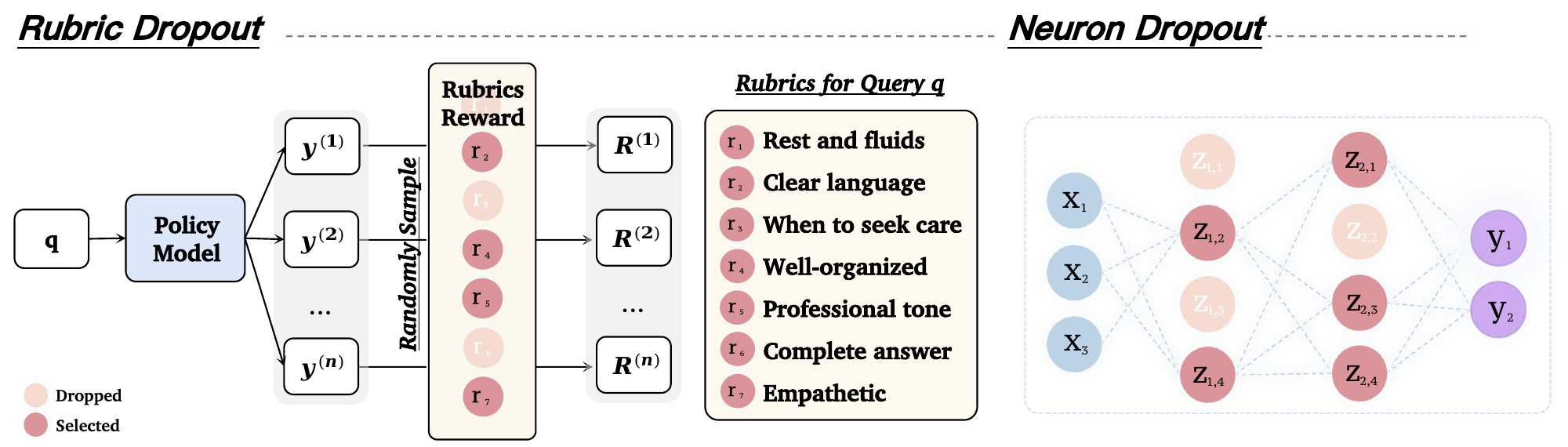
Rubric Dropout: A Simple Way to Mitigate Reward Hacking in Rubric-as-Reward RL
Minglai Yang, Xinyu Guo, Utkarsh Tyagi, Mian Zhang, Razvan Dumitru, Sunjie Hou, Yunzhong He, Daniel Yue Zhang, Ying Liu
- Showed that rubric-as-reward RL reward-hacks out of distribution: the training judge’s score keeps rising while a stronger gold judge’s score peaks and falls by 22 points on ResearchQA.
- Proposed Rubric Dropout, which randomly drops rubric criteria at every step, raising the out-of-distribution gold score by +6–7 points on ResearchQA with no in-domain cost.
Reasoning Mechanisms
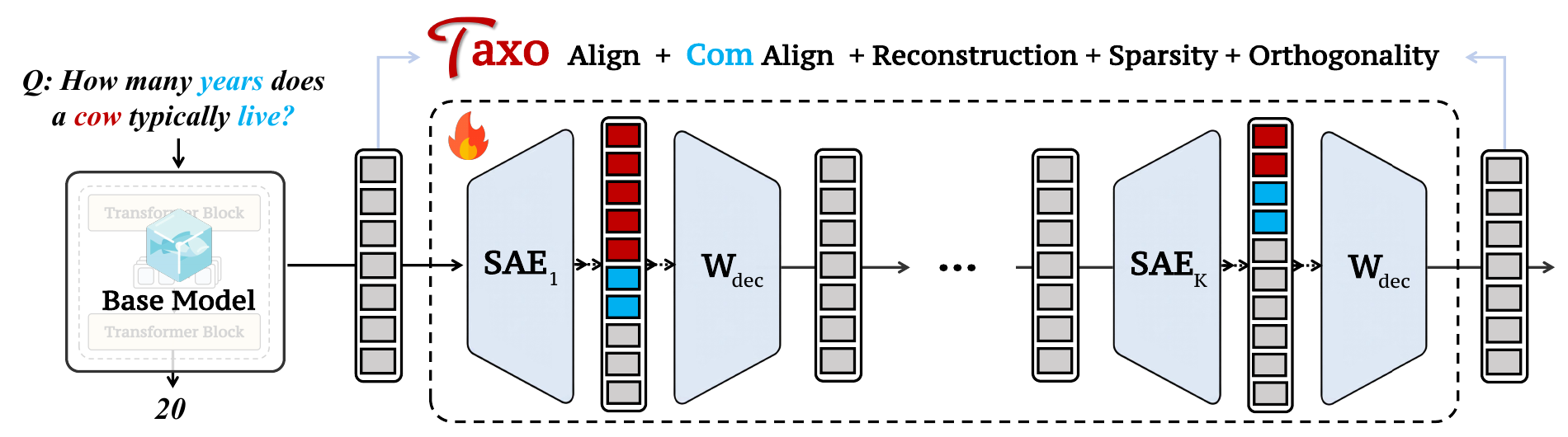
TaxoSAE: Rethinking Sparse Autoencoders through Taxonomic Logic
Xinyu Guo, Minglai Yang, Clayton T. Morrison, Eduardo Blanco, Mihai Surdeanu
- Showed that existing SAEs learn a flat feature space, so concept readout lacks taxonomic consistency and control lacks the granularity to scope an edit.
- Proposed TaxoSAE, which mirrors a taxonomy with stacked SAEs and a taxonomic alignment loss; only terminal concepts need supervision.
- Improved hypernym readout of unseen abstract concepts by +31.3 points and swap success by +25.5 points; suppressing a concept removes only its own answers.
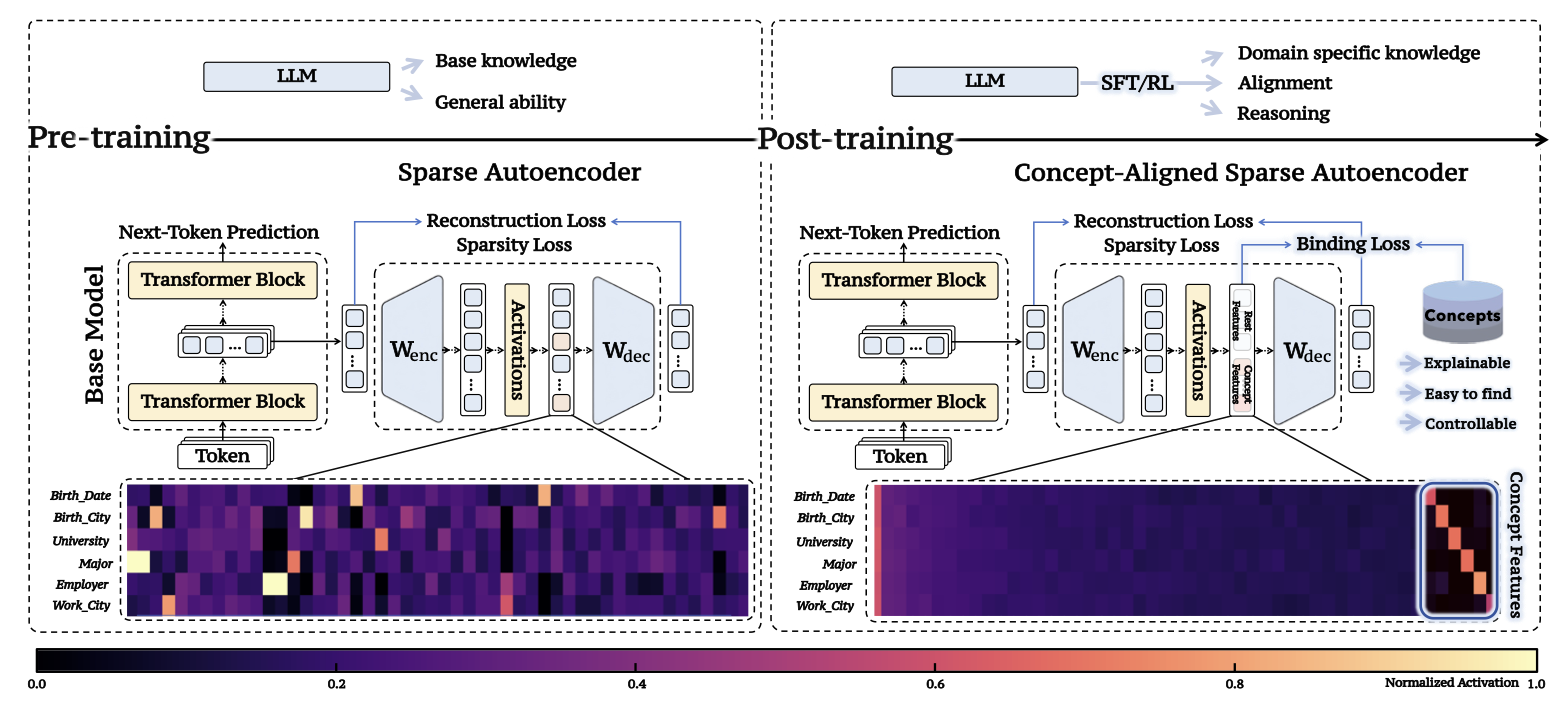
AlignSAE: Concept-Aligned Sparse Autoencoders
Minglai Yang, Xinyu Guo, Zhengliang Shi, Jinhe Bi, Steven Bethard, Mihai Surdeanu, Liangming Pan
PDF | Code | OpenReview
- Showed that unsupervised SAEs fragment human-defined concepts across many entangled features.
- Proposed a “pre-train, then post-train” curriculum that binds each ontology concept to a dedicated latent slot.
- Enabled reliable concept swaps (94.8%) and 9–∞× better disentanglement than standard SAEs; used the aligned slots to probe multi-hop reasoning and grokking-like dynamics.
Other Publications
- From Copying to Composition: How Language Models Develop In-Context Learning, Minglai Yang, Xinyu Guo, Renxiong Wang, Daniel Yue Zhang, Yunzhong He, Under Review, 2026
- Dr. DocBench: A Comprehensive Benchmark for Expert-Level and Difficult Document Parsing, Minglai Yang, Xinyan Velocity Yu, Pengyuan Li, Xinyu Guo, Zhenting Qi, et al., NeurIPS Workshop (LCFM), 2026
- RecuritOpsBench: When Agents Fail to Ask for the Information They Need, Yunze Xiao, Jienan Chen, Xinyu Guo, Minghao Liu, Zihan Wang, Weihao Xuan, Under Review, 2026
- Deep Research: A Systematic Survey, Zhengliang Shi, …, Xinyu Guo, …, Zhaochun Ren, Under Review, 2025
- QUEST: Query Optimization in Unstructured Document Analysis, Zhaoze Sun, Qiyan Deng, Chengliang Chai, Kaisen Jin, Xinyu Guo, Han Han, Ye Yuan, Guoren Wang, Lei Cao, VLDB, 2025
📖 Education
- 2024 - now: Ph.D. in Computer Science, University of Arizona, Tucson, AZ. Advisor: Prof. Mihai Surdeanu. GPA: 3.86/4.0.
- 2019 - 2023: B.E. in Computer Science, Shandong University, China. Graduated with Honors. GPA: 3.8/4.0.
💻 Internships
- 2026.05 - 2026.10, Research Scientist Intern, Abaka AI, Mountain View, CA.
- Agentic RL Training: built an internal agentic RL training framework supporting MCP-based tool use and RL training; post-trained Qwen3-8B on 2K synthesized tasks, raising Pass@1 on τ²-bench Retail from 31.6% to 60.2% (RetailServe blog).
- Document parsing: contributed to Dr. DocBench (NeurIPS 2026 LCFM Workshop), and helped organize the Dr. DocBench challenge at the DocInsights Workshop @ EMNLP 2026.
🔬 Research Experience
- 2025.03 - now, Graduate Research Assistant, CLU Lab, University of Arizona, Tucson, AZ.
- Advisors: Prof. Mihai Surdeanu, Prof. Eduardo Blanco, Prof. Clayton T. Morrison.
- Research topics: NLP, LLM reasoning mechanisms. Publications: CogRE (EMNLP), AlignSAE (TMLR), TaxoSAE (under review).
- 2023.09 - 2024.09, Undergraduate Research Assistant, CAES Research Center, Shandong University, China. Advisor: Prof. Zhongxing Yu.
- C++ type conversion bugs: built a dataset of 226 real-world type conversion bugs from 10 major C++ projects (e.g., V8, PyTorch, OpenCV, MySQL), summarized root-cause and fix patterns, and designed a tool to automatically detect and repair them.
- Code clone detection & repair (undergraduate thesis): applied SemanticCodeBERT, which extends GraphCodeBERT with semantic flow graphs and five structure-aware pre-training tasks; outperformed GraphCodeBERT on BigCloneBench clone detection and Transformer baselines on Bug-Fixes code repair.
- 2022.02, Oxford Winter Exchange Program, Oxford University, UK. Advisor: Prof. Jeremy Pitt. Topic: Human-centered AI.
🎖 Honors and Awards
- 2026: Galileo Circle Scholarship, University of Arizona
- 2024, 2025: Science Graduate College Fellowship, University of Arizona
- 2023: Outstanding Undergraduate Thesis Award, Shandong University
- 2023: Outstanding Graduate Student, Shandong University
- 2022: Academic Scholarship, Shandong University
- 2021: 18th Certified Software Professional Examination, Top 4.57%, CCF
🤝 Grants and Services
- Co-PI, ABC SEED Grant, Arizona Astrobiology Center
- Reviewer, ACL Rolling Review (ARR) 2026, NeurIPS Workshop (LCFM) 2026
📚 Teaching
- 2024, 2025: Teaching Assistant, University of Arizona. Courses: CSC337 Web Programming, CSC460 Database, CSC477/577 Computer Vision.
- 2023: Teaching Assistant, Shandong University. Course: Software Engineering.